Saints of the Family of Saint Basil the Great
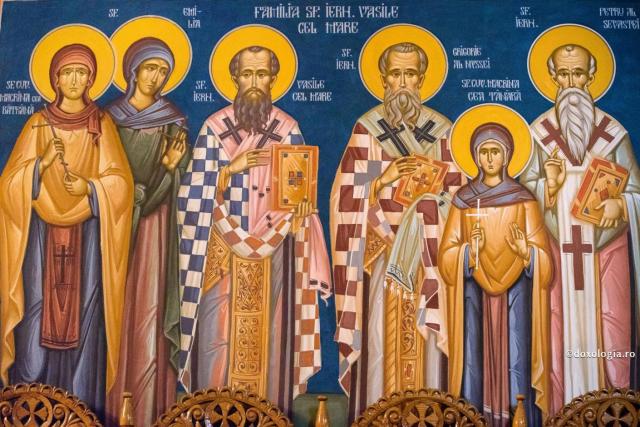
This holy family includes St. Basil the Great, his parents Basil and Emmelia, his siblings Gregory of Nyssa, Peter of Sebaste, Naucratius, and Macrina, and their grandmother Macrina the Elder.
The Saints of the Family of Saint Basil the Great – Synaxarion
On the 19th day of July, we celebrate the memory of the holy Family of Saint Basil the Great: his grandmother Macrina, his parents Basil and Emmelia, his brothers: Gregory, Bishop of Nyssa, Peter, Bishop of Sebaste, and the hermit Naucratius, and his sister, the Venerable Macrina.
**Saint Basil the Great** was born in the year 330 in Caesarea of Cappadocia to faithful and wealthy parents, Saints Basil and Emmelia. A lover of learning, the child Basil studied in the schools of his city, then in those of Constantinople, eventually going to Athens, which was the highest school of his time. There he met Saint Gregory the Theologian, with whom he formed a close and holy friendship. After finishing his studies, he investigated the life of monks in Egypt and Palestine, becoming a monk himself and founding a monastery in Pontus. In 370, he was called to the dignity of Archbishop of Caesarea in Cappadocia (today Kayseri, Turkey) during difficult times for the Church, as the Arian heretics had the support of Emperor Valens himself. Saint Basil the Great drew the emperor's wrath and suffered many persecutions for defending the dogma of the Holy Trinity, the foundation of the Christian faith. He established hospitals and asylums alongside churches for the benefit of the poor and sick, urging the wealthy to give from their riches to help the needy. He had a special connection with the Church north of the Danube (Dacia), in the current territory of Romania, sending missionaries to Christianize the Goths and requesting from there the relics of the Holy Martyr Sabbas the Goth. He departed to the Lord at the age of 49, on January 1, 379, mourned by Orthodox Christians and pagans alike, who loved and honored him for his kindness and wisdom. He left the Church a legacy of many theological writings: On the Holy Spirit, Against Eunomius, Homilies on the Hexaemeron, Monastic Rules, over 300 letters, and other spiritual writings and prayers, as well as the Liturgy that bears his name, which is served ten times a year.
**Saint Macrina the Elder**, the grandmother of Saint Basil, was born in Neocaesarea of Pontus and received Christian teaching from Saint Gregory the Wonderworker. She married a Christian whose name has not been preserved, alongside whom, during the persecution of Diocletian (303-305), she was forced to flee for seven years and suffered the seizure of her property. After the persecution ended, she returned, living a life of poverty. She instilled in her grandchildren the courage to confess the true faith and was their first teacher and example of virtue.
**Saint Basil**, the father of the great Hierarch of the same name, was a famous teacher of rhetoric and a merciful Christian toward the poor, and **Saint Emmelia**, his wife, was the daughter of a believer who had died as a martyr for Christ. They had 10 children, whom they raised in the right faith and in virtuous Christian living.
**Saint Gregory of Nyssa** was the younger brother of Saint Basil the Great. He was born around the year 332 and studied in the schools of his city, Caesarea of Cappadocia. Due to his thirst for knowledge and the great light of his thought and writings, he became a great teacher, father, and theologian of Orthodox spiritual life. From his youth, he entered the service of the Church as a reader, but later became a teacher. During the time of the Arian Emperor Valens (364-378), Saint Basil the Great, who was archbishop in Caesarea of Cappadocia, called his brother Gregory to fight against Arianism, ordained him a bishop, and entrusted him with the see of the city of Nyssa in Cappadocia (today Nevşehir, Turkey). It was not a prominent city, but Saint Basil wanted bishops around him with unwavering Orthodox faith: 'It is better for the bishop to give honor to his see than for the bishop to receive honor from the see,' he said. In this struggle, Saint Gregory was exiled by the Arians from his see for four years. But the reception given to him by the faithful when he returned showed how much he was loved by his flock. The Synod of Antioch (379) sent him to Arabia and Palestine to bring peace to the Churches disturbed by heretics. He took part in the Second Ecumenical Council in 381, strengthening the faith in the divinity of the Holy Spirit. His writings made him a 'Father of Fathers' and a 'pillar of Orthodoxy,' being works of solid theological thought, Christian philosophy, and high inner experience, such as: The Great Catechetical Oration, On the Making of Man, The Life of Moses, Commentary on the Song of Songs, On the Beatitudes, The Christian Way of Life, and others. He departed to the Lord in the year 395, on January 10, leaving us a testimony to the full measure of his great gifts. A portion of his relics can be found in Romania, at the Domnița Bălașa Church in Bucharest, a Patriarchal Chapel.
**Saint Peter of Sebaste** was the youngest of the children of Saints Basil and Emmelia. He was born in 340 in Caesarea of Cappadocia. Saint Macrina the Younger, his older sister, took charge of his formation, instilling in him a love for prayer, asceticism, and almsgiving. Renouncing the study of secular sciences, Saint Peter dedicated himself to the study of Holy Scripture and growth in spiritual life. Shortly after his brother Basil was ordained archbishop of Caesarea in 370, Peter was ordained to the priesthood by him. His spiritual qualities recommended him for higher dignity in the Church, but Saint Peter avoided it as much as possible, loving the silence of solitude and asceticism through fasting, vigils, and the study of holy writings. After his father's death, Saint Peter helped his sister and mother organize a monastic community where they dedicated themselves to the mission and philanthropy of the Church. He later turned the family home into a church institution for virgins. When the provinces of Pontus and Cappadocia were affected by a great drought, the monastic and relief institutions managed by Saint Peter and his family offered grain and other provisions to all hungry and needy people. Around 378, after much insistence from Basil the Great, Saint Peter received the high ministry of the episcopacy as Bishop of Sebaste, in the province of Armenia (today Sivas, Turkey). With much zeal and worthiness, Saint Peter restored the Orthodox faith in the diocese after the death of the Arian bishop Eustathius and participated in the Second Ecumenical Council of Constantinople in 381, where the text of the Orthodox Creed was finalized. Saint Gregory of Nyssa said of his brother that 'he seemed to be no less than Basil the Great in virtue.' Although no writings of Saint Peter have been preserved, at his urging, Saint Gregory of Nyssa wrote his great work, Against Eunomius. Saint Peter fell asleep in peace in the year 391.
**Saint Macrina the Younger** was the older sister of Saint Basil the Great. From her youth, she dedicated her life to the service of God and helping the poor. Adorned with physical beauty and a good nature, she was betrothed to a suitor like her, but he died shortly after. Many others then came to take her as a wife, but the blessed one chose virginity, helping her mother, Saint Emmelia, with household chores and raising her younger brothers like a second mother. The saint occupied herself with reading the Divine Scriptures, striving to guide her brothers on the path of following Christ, making the family home a school of good deeds. Together with her brother, Saint Basil the Great, they founded two monasteries in Pontus, one for women and one for men. The one for monks was guided by Saint Basil the Great, and the other by the abbess Macrina, who, after their mother Saint Emmelia reposed, distributed her wealth to the poor. She lived with great propriety, labor, and prayer, earning what was necessary through work until her final breath. Visiting his sister shortly before her end, Saint Gregory of Nyssa found her completely weakened by fever and lying on a board. The poverty in the monastery of the virgins was so great that they barely found an old veil to cover Macrina's body when they took her to the grave. Then, Saint Gregory placed his mantle over her. During her life, Saint Macrina also performed many miracles, giving healing to the sick and the possessed through her prayers. The blessed one fell asleep in peace in 380 and was buried in the Church of the 40 Martyrs, next to the grave of her mother, Saint Emmelia; her memory is celebrated on July 19.
**Saint Naucratius** was born in 332. He received an excellent education and distinguished himself by his physical beauty and strength from his youth, but also showed deep scholarly knowledge, so that at 22 he read his written works in public, amazing listeners with his skill in composing speeches. Nevertheless, the young Naucratius fled from worldly life and, together with his servant Chrysaphius, retired to the forested banks of the Iris River. There, the young Naucratius found a place of asceticism where he dedicated himself to fasting, vigils, reading holy books, and the salvation of his soul. With his own hands, he cared for several elderly people living nearby in poverty and weakness. One day, Saint Naucratius went to catch fish for the elders he cared for and, falling into the water, passed away unexpectedly in 358, at the age of 26.
The Saints of the Family of Saint Basil the Great have been honored as patrons of Christian families and examples of holiness through a common service since the 19th century, and the Orthodox Church of Greece officially established this common feast in 1998. The Holy Synod of the Romanian Orthodox Church, by its decision of July 1, 2025, set their feast on July 19.
English translation adapted from the Romanian life published by Doxologia.ro.