Saint Cyril, Archbishop of Alexandria
Champion of the Third Ecumenical Council, Saint Cyril defended the title Theotokos and the unity of Christ's person against Nestorianism, earning the title 'Judge of the World' for reconciling the Church in truth.
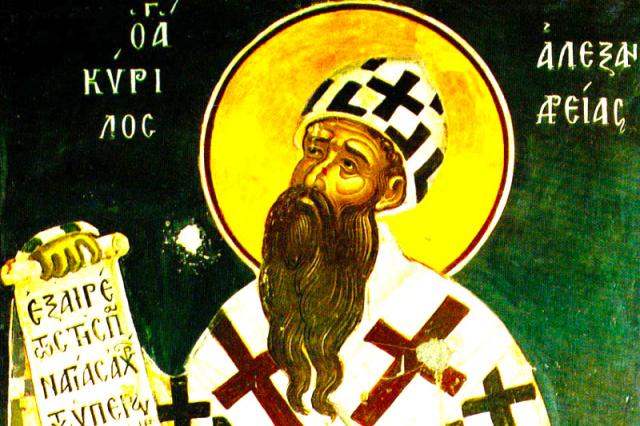
Saint Cyril, Archbishop of Alexandria, 'Judge of the World'
The title 'Judge of the World' signifies the wondrous judgment the Saint rendered for the whole world, uniting all through the right faith, which at that time was divided by the heresy of Nestorius.
Saint Cyril received great honor at the Third Ecumenical Council because, as John Zonaras relates in the encomium he composed for Saint Cyril, the Fathers of the Third Council granted the divine Cyril these privileges: to be called 'Judge of the World' and to wear upon his head, when serving the Holy Liturgy, a thin shroud like a mandylion. The name 'Judge of the World' indicates the wonderful judgment he rendered, uniting the world in the true faith. The thin shroud signifies the subtlety of the Saint's mind and thoughts, with which he strengthened and dogmatized the hypostatic union; for through this definition, both the one person of Christ and His two natures are shown together. Likewise, he was called 'Pope,' a title that entered into the tradition of his successors. At the same time, they adopted the custom of wearing two miters—though not two distinct miters, but a single one adorned with two points. They also granted him two epitrachelia, not separate, but as one: joined in the middle and separated at the bottom, giving the impression of being two.
We wish to draw attention to the fact that until the aforementioned council gathered to strengthen and establish the true faith, Saint Cyril suffered much dishonor and toil. He was greatly wronged and persecuted by the heretics who shared Nestorius's views, for they, aided by worldly officials, held their own council and spread the lie that the divine Cyril was a heretic and of one mind with Apollinarius the Younger, who lived in the second half of the 4th century. This heretic attributed to Christ a human body and a human soul, but not a rational mind, placing the divine Logos in its stead. In place of a correct understanding of the God-Man, Apollinarius's god wore a body, while Nestorius's god was a man who bore God. The humanity of Christ mutilated by Apollinarius implies only a partial salvation. He could not understand that to be an absolute Savior, it was necessary for Christ to be not only fully God, but also fully Man. This heresy was combated by Saints Athanasius, Gregory the Theologian, Basil the Great, and Epiphanius.
English translation adapted from the Romanian life published by Doxologia.ro.