Saint Demetrius, Metropolitan of Rostov
The incorrupt relics of Saint Demetrius of Rostov were discovered in 1752 during cathedral repairs, forty-three years after his repose, revealing his body and vestments perfectly preserved despite humid conditions.
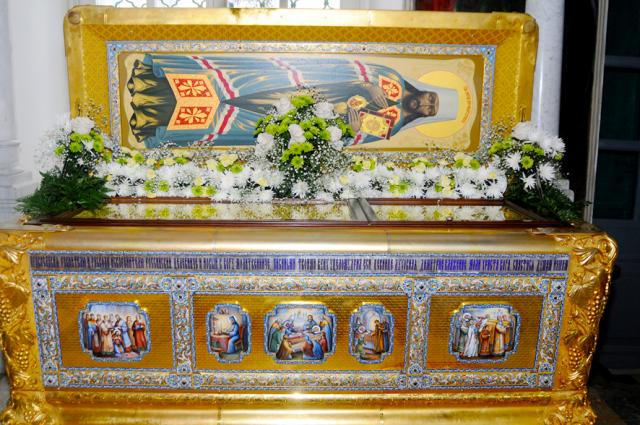
The Discovery of the Relics of Saint Demetrius, Metropolitan of Rostov
In the year 1752, repairs were carried out at the Cathedral of the Conception of the Most Holy Theotokos. On September 21, nearly 43 years after his repose, the entire and incorrupt body of Saint Demetrius was discovered. The grave had been affected by dampness and the oak coffin had rotted, with the inscriptions erased, but the saint's body, omophorion, sakkos, mitre, and prayer rope remained intact. Following the discovery of the Holy Relics, many miraculous healings occurred.
The discovery of the relics of Saint Demetrius, Metropolitan of Rostov, is celebrated on September 21.
In 1702, Saint Demetrius, Metropolitan of Rostov, arrived at the cathedral in Rostov and also visited the Monastery of Saint Jacob, Metropolitan of Rostov (commemorated November 27 and May 23).
Three days before his death, Saint Demetrius began to grow very weak and developed a cough. On October 26, 1709, on his name day, he celebrated the Divine Liturgy in the Cathedral of the Conception of the Most Holy Theotokos. Afterward, he indicated to those present the place where he wished to be buried, on the right side of the cathedral, saying: 'Behold my resting place! Here I will rest for eternity!'
Saint Demetrius fell asleep in the Lord on October 28, 1709.
After he was dressed in all the hierarchal vestments he himself had prepared before his end, his holy body was placed in the coffin. Under his head, in place of a pillow, and according to his command, various books he had composed and written by hand were placed. On that same day, he was set in the church near the hierarchal cell.
When the whole city of Rostov heard of the falling asleep of this good shepherd, a great many people gathered at his honorable body, weeping for their good teacher who helped them in their needs and sorrows, guiding both laypeople and monks and priests alike.
Contrary to the saint's wish expressed in his will, the clergy and people of Rostov asked the locum tenens of the patriarchal throne, Metropolitan Stefan Yavorsky of Ryazan, to perform the burial in the city Cathedral, where all the former hierarchs of Rostov were buried.
Metropolitan Stefan insisted on burying his deceased friend near Saint Joasaph, the predecessor of Saint Demetrius. However, the grave was not prepared by the time Metropolitan Stefan arrived, even though about a month had passed since the saint's death.
On November 25, 1709, Metropolitan Stefan, together with the assembly, celebrated the Divine Liturgy and then the funeral service. Afterward, they took him to the Monastery of Saint Jacob and placed him in the grave in the Cathedral of the Conception of the Most Holy Theotokos, on the right side as he had indicated, alongside Saint Joasaph (his predecessor).
Because the grave was not yet ready upon Metropolitan Stefan's arrival, a wooden frame was quickly constructed in which the saint's body was buried. This detail, provided by the providence of God, led to a rapid discovery of the Holy Relics.
In the year 1752, repairs were carried out at the Cathedral of the Conception of the Most Holy Theotokos, and on September 21 (nearly 43 years after his repose), the entire and incorrupt body of Saint Demetrius was discovered. The grave had been affected by dampness and the oak coffin had rotted, the writing was erased, but the body of the saint, the omophorion, the sakkos, the mitre, and the prayer rope remained intact.
After the discovery of the Holy Relics, many miraculous healings occurred, which were reported to the Holy Synod. The Synod sent Metropolitan Sylvester of Suzdal and Archimandrite Gabriel Simonov to Rostov to investigate the relics of Saint Demetrius and to learn details about the miraculous healings.
On April 29, 1757, the Holy Synod issued a decree canonizing Saint Demetrius, Metropolitan of Rostov, numbering him among the saints and establishing as feast days October 28 (the day of the saint's repose) and September 21 (the day his holy relics were discovered).
English translation adapted from the Romanian life published by Doxologia.ro.