Saint John Jacob of Neamț the Chozebite
A 20th-century Romanian ascetic who lived in the Judean Desert, known for his poetic writings, profound humility, and pre-knowing the date of his repose in his cave at Choziba.
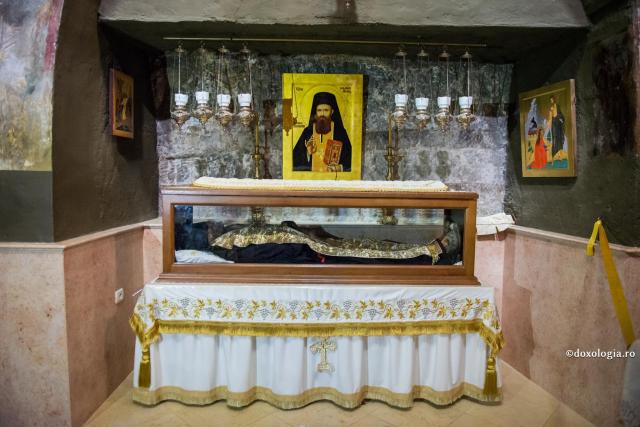
The Venerable Who Knew the Date of His End, Marking It on a Cave Wall
In the summer of 1960, he became ill with dysentery, kidney problems, and pneumonia accompanied by a very high fever. These aggravated conditions required careful care from his disciple, who applied vinegar compresses and cupping to reduce his temperature. Due to great suffering and physical weakness, the Saint often thanked his disciple only with his gaze. On the morning of the day he fell asleep in the Lord, at about 7:00 AM, after finishing his prayer rule, he partook of the Holy Mysteries of our Lord Jesus Christ. His disciple then came to him in the cave, and the Saint said to him: 'Father Ioanichie, I have been waiting so long for you to come, for these three days have been a martyrdom for me. I have been very ill, I caught a bad cold, I am coughing and cannot breathe, and I have a high temperature.' Then, Father Ioanichie wanted to apply compresses and cupping again, but the saint replied gently that now nothing more was needed, for everything was over and in a short time he must depart to the Lord.
He washed his face and hands himself, combed his hair, and then began to look with great wonder toward heaven, saying: 'Father Ioanichie, if only your holiness could see what I see!' to which the disciple asked: 'What do you see, Father John?'. And the saint told him: 'I see many angels and saints bringing two beautiful crowns of flowers and palm branches on which is written: Blessed are those who...' and he stopped. Then, Father Ioanichie asked him: 'And what else does it say?'. But the saint said: 'If I feel better, I will tell you later.' And on the other crown to his left was written: 'Cursed are those who...' and he would not say the remaining words. But he said that above the crown on the left he saw lightning and arrows like thunderbolts starting, which depicted the wrath of God upon those who die unrepentant. Then he told the disciple that, after he died, his body should be buried here, in this cave, in a canal built of stone and cement, which he himself had prepared in advance. Then, Father Ioanichie asked Saint John: 'Father John, but when I die, where will they put me?'. To which the saint replied: 'I will move over a little and your holiness will come beside me.' (Here I make a small parenthesis, wanting to show the humility of Father Ioanichie toward Saint John, when he became a little saddened and then with a somewhat severe tone said to me: 'How long do you think I can still endure you, Father Visarion? For since I have been here in the Holy Land, in 56 years no one has nagged and questioned me as much as your holiness. For this I give you a rule to write everything you have learned from me and from other Romanians you have caught alive, everything you know about the life and struggles of Saint John.')
Although it was the beginning of August and the temperature outside exceeded 40 degrees Celsius, Saint John was very cold, coughing, and had a high fever. But despite all this, he was very lucid, gentle, and peaceful. It was Thursday, August 5, 1960, when, after giving his final advice to his disciple, he stood up and with his right hand began to bless, as a priest, with the sign of the Holy Cross for nearly an hour, in all directions of the cave. He was likely blessing the saints whom he had said earlier he saw coming to meet him and whom he glorified and praised in his writings. Then, he stretched out on the wooden bed, on which he had only a single blanket, closed his eyes, took a deep breath, and gave his soul into the hands of God. His disciple, Father Ioanichie, remained kneeling for a long time by the head of his father, weeping with bitter tears for the one who had left him here on earth and who had been his confessor and good teacher and guide, Saint John Jacob the Romanian. As long as he was sick, he never sighed or moaned. He endured with peace, with serenity, and received them all with joy, as gifts from God. The Venerable John knew the date of his end beforehand, marking it on the wall of the cave.
English translation adapted from the Romanian life published by Doxologia.ro.