Saint Lupus the Martyr
The faithful servant of St. Demetrius of Thessaloniki, St. Lupus was martyred for his courageous confession of Christ and for performing miracles through the blood-stained relics of his master.
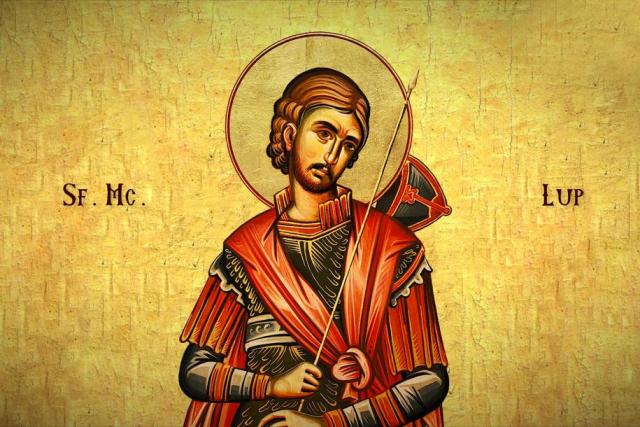
Saint Lupus (or Lup in Romanian calendars) lived, according to tradition, at the end of the 3rd century and the beginning of the 4th century. He was the servant of the Holy Great Martyr Demetrius the Myrrh-streamer, who is honored with great reverence by all Orthodox faithful on October 26. Lupus followed his master into martyrdom shortly thereafter. His name suggests a Latin origin, although his roots in the Danubian region could also mean he was a Romanized local. On August 23, when he is commemorated in our Church's calendar, several saints with this name are mentioned in the ancient Synaxaria.
Saint Lupus, Servant of a Martyr
According to hagiographic collections such as the *Synaxarium Ecclesiae Constantinopolitanae* and *Acta Sanctorum*, Lupus was the servant of Saint Demetrius the Myrrh-streamer, who was martyred during the reign of Emperor Maximian Galerius (293-311) in Thessaloniki. This account is found in contemporary Greek and Romanian Menaia for August 23. After his master’s martyrdom, Saint Lupus dipped the hem of his garment and a ring into the blood of the Great Martyr (the ring apparently belonged to Saint Demetrius himself) and began to walk through the city with them, confessing the Christian faith and healing the sick through these precious treasures. This information is also found in the 8th Ikos of the Akathist to Saint Demetrius; the 3rd Ikos of the same hymn states that the Great Martyr, before his martyrdom, entrusted all his wealth to Lupus with the command to distribute it to the poor.
Perhaps the similarity between Lupus, the servant of Saint Demetrius, and another martyr named Lupus, who had been a slave, led to the identification of the two in the modern cult of the saint. Like this second version, Lupus not only performed healings and miracles but also destroyed the statues of gods in a Roman temple. Because of this, he began to be persecuted by the servants of that pagan altar, though he remained unharmed. Eventually, the saint surrendered himself and was beheaded with a sword on August 23, possibly in the year 304, or according to Russian versions, after 306.
Since the biographies of other holy martyrs with the same name show similarities, we will present them below. Whether they refer to one and the same person is difficult to determine.
Saint Lupus, the Martyr Slave
Greek, Latin, Syriac, and Coptic Menaia also commemorate on August 23 another Saint Lupus, a slave of an unknown master "but free in Christ the Lord, in Whom he believed" (cf. 1 Cor 7:22). He entered a temple and smashed the statues of the gods there, for which reason the temple servants wanted to kill him with swords; instead, losing their minds, they killed each other. Then, unable to approach him, other persecutors tried to kill him from afar with arrows, but the arrows turned back against them. This detail regarding the smashing of idols somewhat resembles the biography of the soldier Emilian of Durostorum, who was martyred for this reason later, during the time of Julian the Apostate (in 362), and is celebrated on July 18. This may explain why Lupus appears in iconography more often in military attire than in official robes and, surprisingly, never as a slave.
Shortly after, Emperor Aurelian (270-275) heard of these events and ordered his soldiers to capture the confessor, which they did. Knowing his end was near, Saint Lupus, who was not yet baptized, prayed to God not to let him die as a pagan. Immediately, rain began to fall on the spot where he was held bound, so that Lupus was miraculously baptized. After this, he was beheaded and joined the host of martyrs. Numerous miracles occurred at his relics.
A cult dedicated to the Holy Martyr Lupus in the south-Danubian region is known from an event described by the Byzantine historian Theophylact Simocatta. According to him, a general named Peter, brother of Emperor Maurice (582-602), visited the fortress of Novae (present-day Svishtov, Bulgaria) during the feast of the Holy Martyr Lupus, who was honored by both nobles and the poor—which may be an indication that this refers to the slave Lupus described here.
Additionally, Slavonic and Greek Menaia make a brief mention on May 23 of a Saint Lupus who was also a slave.
Saint Lupus, the Martyr Bishop
Slavonic Menaia also celebrate another Saint Lupus on August 23, who was a bishop—likely in Sirmium—although contemporary documents do not mention a hierarch by this name in the capital of the province of Illyricum. It seems this localization may have been influenced by the fact that on August 23, there is a brief mention of Saint Irenaeus of Sirmium (normally celebrated on April 6); this commemoration itself is likely an erroneous association with Saint Irenaeus of Lyon, who is also celebrated on August 23.
Another Slavonic Synaxarion mentions Saint Lupus only as a church writer who died in 205 during the reign of Septimius Severus.
As in many other hagiographies, one can observe that transcriptions, translations, and the desire of copyists not to lose any detail of the saints' lives often led to biographical overlaps, contaminations, and confusions. These are all the more difficult to identify as the testimonies come from multiple sources. In the specific case of Saint Lupus, whether it concerns a single martyr or three (or even four) of different social standings, the power of their witness unto death and their miracle-working faith serves as an example for Christians today.
English translation adapted from the Romanian life published by Doxologia.ro.