Saint Philotheus I Kokkinos, Patriarch of Constantinople
A 14th-century Patriarch of Constantinople and prolific Hesychast theologian, Saint Philotheus was a disciple of Saint Gregory Palamas and a vigorous defender of Orthodox doctrine and liturgical life.
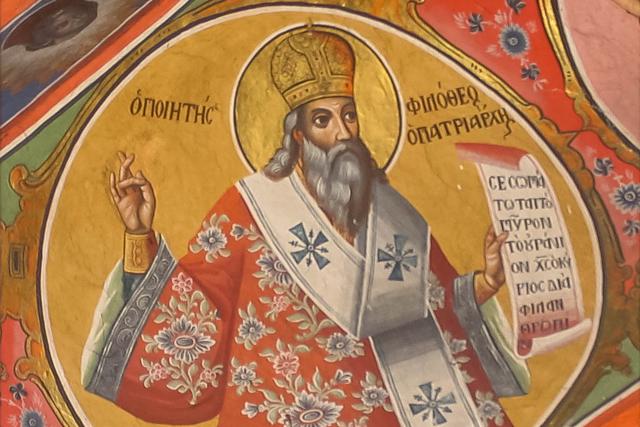
Saint Philotheus Kokkinos was one of the most renowned and prolific hierarchs of our Church and one of the greatest Ecumenical Patriarchs.
Born around the year 1300 in Thessaloniki, he received the name Phocas at baptism. His mother came from a Jewish family. He received an exceptional education from Thomas Magistros, in whose service he was employed. He embraced monasticism early and withdrew to Mount Sinai. From there, he went to Holy Mount Athos, "the truly golden and beloved cause of good for all who have lived and live in it," as his biographer writes.
At first, he lived at Vatopedi Monastery, where he met Saint Sava the Fool-for-Christ, for whom he became an excellent biographer. He then went to the Great Lavra Monastery, where he became a disciple of Saint Gregory Palamas, whose life he would later write. In 1339, he signed the Hagioritic Tome. In 1342, he became the abbot of the Great Lavra, succeeding Macarius when the latter was elected Metropolitan of Thessaloniki. The period in which he was abbot was by no means free of problems. From the beginning, Saint Philotheus was a supporter of Saint Gregory Palamas.
In 1346, he wrote two treatises: "On the Taboric Light" and "Against Akindynos."
In 1347, he was elected Metropolitan of the First-Seated Throne of Heraclea in Thrace, with the title "Exarch of the Most Holy Bishops," by Patriarch Isidore. In 1350, he ordained the Hagiorite Saint Callistus I as patriarch. He took part in the Hesychast Synod organized in Constantinople in 1351, playing an important role in supporting Hesychasm alongside Saint Gregory Palamas. He also composed the Tome of the Synod's Acts.
He served as Ecumenical Patriarch twice: between 1353 and 1354, and between the years 1364–1376. In 1368, in his capacity as Ecumenical Patriarch, he convened a synod in which the sanctity of Saint Gregory Palamas was recognized, deciding that his commemoration should be held on the Second Sunday of Great Lent. On this occasion, he also composed the service for the Saint. Additionally, the anti-Palamites were condemned during this synod.
The pastoral activity that Saint Philotheus carried out as Ecumenical Patriarch was very rich. He conducted vast literary and administrative work. He handled ecclesiastical matters with such wisdom and discernment that the Ecumenical Patriarchate acquired the status of a lighthouse of ecumenical Orthodoxy during his time. He fought tenaciously against the Ottoman threat and Latin propaganda by strengthening and uniting the Orthodox. Pope Urban V rejected his initiative to organize an Ecumenical Council for the proper union of the Churches.
Due to his very vast education, he distinguished himself as a remarkable and multifaceted writer. His works can be classified as dogmatic, polemical, and refutations of the theories of Nicephorus Gregoras, Akindynos, Barlaam, and Manuel Petriotis. Many of his works are hagiographical. He wrote especially about the Hagiorite Saints, such as Gregory Palamas, Germanus Maroulis, Isidore Voucheiras, and Sava of Vatopedi, as well as Nicodemus the New (of Tismana). He also wrote about Saint Anysia, Saint Demetrius the Myrrh-streamer, the Holy Apostles, the Three Holy Hierarchs, the Synaxis of All Saints, Saint Onuphrius, Saint Febronia, Saint Phocas, Saint John Chrysostom, Saint Theodore Tyro, the Apostle Thomas, and many other saints. He is also the author of prayers.
His other works are homiletic, hermeneutical, liturgical, canonical, historical, and poetic. He is also an author of Synaxarion lives, etc. His works cover almost all branches of theology.
He was a theologian of great depth, the author of wonderful Synaxarion lives, especially of contemporary Hagiorite Saints, whose conduct he offered as an example to be followed by the monks in the monastery where he himself lived.
As a hymnographer, he distinguished himself by his profound content and elegant style, and for the refinement with which he presents high theological meanings, successfully competing with the works of illustrious predecessors in the field.
Whether a monk of Vatopedi, abbot of the Lavra, Metropolitan of Heraclea, or Ecumenical Patriarch, Saint Philotheus labored everywhere and at all times with a devotion pushed to the point of sacrifice and with a love for the Church, in whose service he placed his word and his pen.
He defended Orthodoxy with great zeal, cultivating relations with the other Patriarchates, helped the Slavic Churches, thwarted the proselytizing efforts of the Latins, and distinguished himself as a defender of his nation and a high hierarch truly worthy of honor. He left the ecumenical throne in 1376 due to old age and fell asleep three years later, in 1379. He was buried with imperial honors in the Akataliptos Christos Monastery in Constantinople. His tomb became a source of miracles.
Very soon, he began to be honored as a saint and was painted in the katholikon of the Ravanica Monastery in Serbia by fellow Thessalonians, master iconographers. In the katholikons of the Holy Mountain, he is usually painted in the narthex among the holy hymnographers.
At the end of the 18th century, a learned monk from Philotheou Monastery wrote hymns for the service of Saint Philotheus as well as a beautiful life of him.
On the Holy Mountain, there are three Codices containing the life and service of Saint Philotheus. A newer service was written by the Venerable Saint Gerasimos Mikragiannanitis.
His commemoration is held on the 5th Sunday of Great Lent and on October 11. He is honored by the Church as a famous ascetic, monk, and defender of the true faith, commemorated alongside Saints Photius the Great, Mark of Ephesus, and Gregory Palamas.
English translation adapted from the Romanian life published by Doxologia.ro.