Saint Irene Chrysovalantou
A 9th-century abbess known for her clairvoyance and miracles, most notably receiving three mystical apples from Paradise sent by Saint John the Theologian.
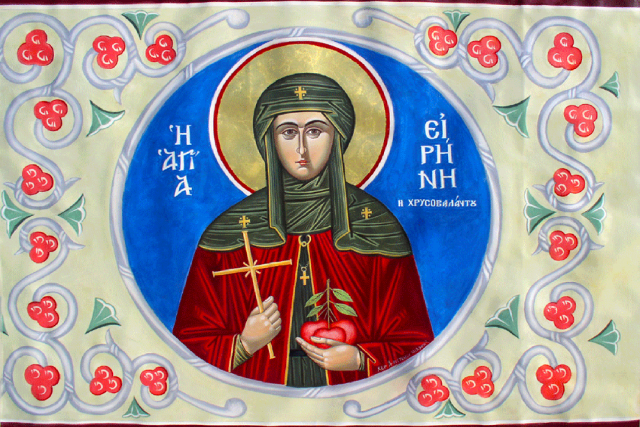
Saint Irene fasted for a week, thanking God for this wonderful gift. When Great Lent began, she ate small pieces of one apple every day. Throughout the entire period of the fast, she ate and drank nothing else, and an indescribable fragrance spread throughout the monastery. On Holy and Great Thursday, Abbess Irene asked the sisters to commune with the Body and Blood of the Lord, after which she gave them pieces of the second apple. The nuns noticed that the apple had an unusual sweetness and felt that their souls were also nourished.
Saint Irene Chrysovalantou, who received apples from Paradise, is commemorated on July 28.
Life and Early Years
Saint Irene was born in the 9th century to a wealthy family in Cappadocia. After the death of her husband, Theophilus, Empress Theodora ruled the Byzantine Empire as regent for her young son, Michael. Saint Theodora (commemorated February 11) supported the Church against the iconoclastic heresy and helped restore the veneration of holy icons. This victory is celebrated on the first Sunday of Great Lent (the Sunday of Orthodoxy).
When Michael turned 12, Saint Theodora sent messengers throughout the Empire in search of a virtuous and refined girl to be the future emperor's wife. Irene was chosen and accepted the marriage to young Michael. On the way to Constantinople, the saint crossed Mount Olympus in Asia Minor. Irene asked her companions to stop so she could receive the blessing of Saint Joannicius (commemorated November 4), who lived on that mountain. He only received the most worthy pilgrims for counsel. He possessed the gift of foresight and foresaw Saint Irene's arrival, as well as what would happen in the future of her life.
The venerable one received her and told her to go to the capital, where the Chrysovalantou Convent was located, as it needed an abbess for the community of virgins there. Amazed by the advice, Irene fell to the ground and asked for Saint Joannicius' blessing. After blessing her and giving her further spiritual advice, the venerable one let her continue her journey.
Entering the Monastery
When she arrived in Constantinople, Saint Irene's relatives (who were nobles at the emperor's court) met her with great honor. Because "the steps of a man are ordered by the Lord" (Psalm 37:23), God arranged for Michael to marry another girl a few days prior, so that Irene could be free to become the bride of Christ. Upon learning this, Saint Irene was not at all saddened, but rather rejoiced at this turn of events and gave glory to God.
Remembering the words of Saint Joannicius, Irene visited the Chrysovalantou Monastery. She was so impressed by the nuns and their way of life that she immediately freed her subjects, distributed her wealth to the poor, and entered the monastery. She traded her expensive clothes for the simple robe of a nun and served the sisters of the monastery with great humility and obedience. The abbess was impressed by how Irene performed the most dishonorable and unpleasant tasks without complaint.
The saint read the Lives of the Saints many times in her cell, imitating their virtues according to her strength. Many times she stood all night with her hands raised in prayer like Moses on Mount Sinai (Exodus 17:11-13). Saint Irene spent the next few years in great spiritual struggles, overcoming the attacks of demons and gaining the fruits of the Holy Spirit: love, joy, peace, longsuffering, kindness, goodness, faithfulness, gentleness, self-control, and purity (Galatians 5:22-23).
Abbess and Wonderworker
When the monastery's abbess felt her departure to the Lord was near, she called the sisters and told them that after her death they should accept no one as abbess but Irene. Then, the abbess gave Irene further advice and instructions. After the abbess was buried, the nuns went for guidance to Patriarch Methodius of Constantinople (commemorated June 14) regarding the selection of the mother who would lead them toward perfection. Unaware of the instructions left by the former abbess, the Patriarch told them that if there was a humble nun named Irene in their community, they should choose her. Rejoicing, the sisters gave glory to God for the choice. Patriarch Methodius elevated Saint Irene to the rank of abbess and advised her on how to lead the monastics up the steps of asceticism.
When she returned to the monastery, Saint Irene prayed that God would help her care for all the sisters entrusted to her for spiritual guidance, while simultaneously intensifying her own labors. She proved very wise in guiding the nuns, receiving numerous revelations from God that assisted her in fulfilling her duties.
For her labors, the saint received from God the gift of foresight, so that she knew in advance the needs and expectations of the sisters. With the help of this gift, she always gave the nuns the appropriate advice. Saint Irene never used the gift of foreknowledge to shame others, but only to correct their shortcomings by utilizing other spiritual gifts they possessed.
Saint Irene performed many miracles during her life. She had the habit of going out into the monastery courtyard on the eves of great feasts to keep vigil under the starry sky. One of these nights, a nun could not sleep and went out into the courtyard. She saw Abbess Irene floating above the ground, completely absorbed in prayer. The nun was also amazed to observe the two cypress trees in the courtyard bent to the ground as if paying homage to Saint Irene. When she finished her prayer, the saint blessed the trees, and they returned to an upright position.
Fearing this vision might be a demonic temptation, the nun returned to the courtyard the next night. Still not believing what she saw, the nun returned a third night, seeing Saint Irene floating in the air again as she prayed, with the cypresses bowing to her. To ensure it was real, the nun tied a handkerchief to the top of each of the two trees. The next day, when the sisters saw the handkerchiefs tied to the treetops, they wondered how anyone had managed to climb so high to tie them. Then the nun confessed all she had seen. When Saint Irene learned that the sister had witnessed the miracle and told the others, she was very saddened. She called the sisters and asked them not to tell anyone about this event until after her death.
The Three Apples from Paradise
Saint Irene had a great devotion to Saint Basil the Great (commemorated January 1), as he was also from Cappadocia. One year, on the eve of his feast, Saint Irene heard a voice telling her to welcome the sailor who would knock at her door the next day, to rejoice, and to eat the fruits he would bring her.
During Matins, a sailor came to the door and remained in the church until after the Divine Liturgy. He told the saint that he had come from the island of Patmos by ship. When the ship weighed anchor, he noticed an old man on the pier calling for them to stop. Despite a good wind, the ship stopped suddenly. Then the old man walked on the water and boarded the ship. He gave the sailor three apples for the Patriarch of Constantinople "from his beloved John the Theologian," and then gave him another three apples for Abbess Irene of Chrysovalantou. The sailor also conveyed that "this gift comes from John in Paradise." The three apples were wondrous.
After this, Saint Irene fasted for a week, thanking God for this wonderful gift. When Great Lent began, she ate small pieces of one apple every day. Throughout the entire period of the fast, she ate and drank nothing else, and an indescribable fragrance spread throughout the monastery. On Holy and Great Thursday, Abbess Irene asked the sisters to commune with the Body and Blood of the Lord, after which she gave them pieces of the second apple. The nuns noticed that the apple had an unusual sweetness and felt that their souls were also nourished.
Her Dormition
An angel of the Lord appeared to Saint Irene and told her she would be called to the Lord on the day after the feast of Saint Panteleimon. The monastery's feast day was July 26, so the saint prepared herself by fasting for a week beforehand. She consumed small pieces of the third apple that Saint John had sent her, and a little water. During this time, the entire monastery was filled with an unprecedented fragrance, and all misunderstandings vanished.
On July 28, Saint Irene called all the sisters to say her farewells. She also told them to choose the nun Maria as her successor, because she would keep them on the narrow path that leads to Life. After asking God to protect her flock from the attacks of demons, she smiled as she saw the angels who came to receive her soul. Then she closed her eyes and fell asleep in the Lord.
Saint Irene was over 101 years old when she died, and her face appeared young and beautiful. A large crowd of people, rich and poor, came to her funeral and became witnesses to many miracles. Even during the funeral service, the monastery was filled with an indescribable fragrance. Countless miracles occurred afterward at the tomb of Saint Irene Chrysovalantou.
Today, there are several churches and monasteries built in her honor, as well as many miracle-working icons. A chapel in honor of Saint Irene was built on Mount Olympus, near the Monastery of Saint Ephraim the Syrian; beside it, the nuns planted a thuja tree in memory of the cypresses that bowed to the saint. Without anyone grafting the thuja, it transformed into a fruit-bearing apple tree, and the nuns distribute these apples to pilgrims as blessed fruits of Saint Irene. In some parishes, it is customary to bless apples on the feast day of Saint Irene Chrysovalantou, which are then distributed to the faithful.
English translation adapted from the Romanian life published by Doxologia.ro.