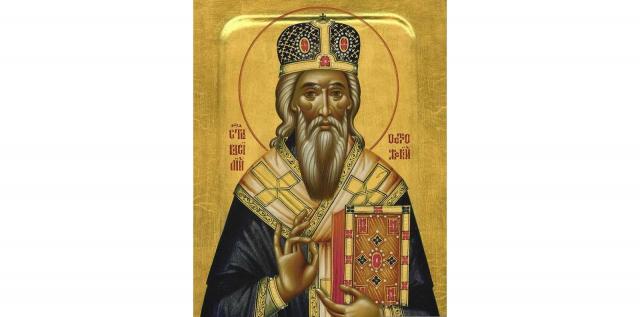
Saint Macarius of Corinth
A central figure of the Kollyvades movement, he compiled the Philokalia and revitalized Orthodox spirituality through the frequent reception of Holy Communion and the practice of the Jesus Prayer.
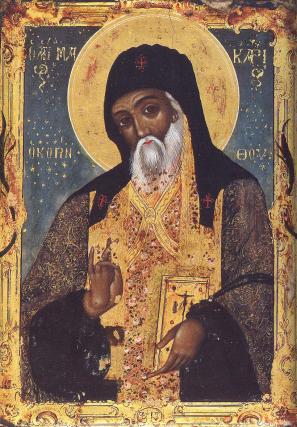
The inhabitants of the island of Chios honored him as a saint even during his lifetime, a veneration that subsequently spread throughout the entire Church.
Saint Macarius Notaras (born Michael) was born in 1731 in Trikala of Corinth into the prominent Notaras family. His father, Georgantas, a notable of the Corinthian province, had nine children with his virtuous wife, Anastasia. Michael was taught his first letters by Eustathios, a teacher from Cephalonia, at the Monastery of the Mother of God. From a young age, he showed an inclination toward works of piety and a love for the Church. As a manager of his family's estates, he was not very effective, for he not only failed to collect taxes from the villagers but even distributed what he had to the poor. His father did not allow him to become a monk at the Monastery of the Great Cave, but he dedicated himself entirely to the study of the Divine Scriptures and Patristic texts.
After the death of his teacher, he took on the responsibility of teaching the students of Corinth for six years without pay. This act aroused the admiration and respect of his fellow citizens, and in 1764, upon the falling asleep of the local metropolitan, the entire clergy and the people of the surrounding area asked the Ecumenical Patriarchate to ordain the teacher Macarius as Bishop of Corinth. The saint considered the common voice of the clergy and people to be the expression of God's will and accepted this hierarchical honor. At the time of his ordination, he received the name Macarius.
As a hierarch, he carried out extensive work of renewal. He cared for the education of the clergy, suspended illiterate and very elderly clerics from service, as well as those involved in political matters. He was very careful about whom he ordained and paid great attention to the holy canons. He oversaw the construction of schools and preached repentance to the unlearned people of his diocese.
His activity was interrupted by the Russo-Turkish War (1768-1774). Following the upheaval caused by the bloody reprisals of the Turks, he fled with his family first to Zakynthos, where he taught the people for three years, and then to Hydra. He was never again permitted to return to his diocese. Without having resigned, he was replaced by another bishop whom the Ecumenical Patriarchate was forced to appoint under pressure. From that time on, he changed his signature to "Macarius *of* Corinth."
In Hydra, he met his future close collaborator, Saint Nicodemus of the Holy Mountain—at that time the layman Nicholas—and the "famous hermit Sylvester," a great ascetic personality. From Hydra, he went to Chios and then, in 1777, to the Holy Mountain, where he settled at the Vatopedi Cell of Saint Anthony alongside Elder David. Here he reunited with Saint Nicodemus, now a monk at Dionysiou, to whom he gave the manuscript texts of the *Philokalia* for editing, asking him to write the Introduction and short biographies of the holy authors of the texts. Saint Macarius had copied the entire contents of the *Philokalia* from various manuscripts in Athonite libraries, "especially from the library of the glorious and Great Monastery of Vatopedi, in which he found treasures—books, that is, about the union of the mind with God, collected from ancient times by great zealots from [the writings] of all the saints, and about prayer..." as Saint Paisius Velichkovsky wrote in one of his letters. The core of the *Philokalia* was gathered by Saint Macarius from the Vatopedi Manuscript Codex 605 from the 13th century, as argued by Professor A. Tachiaos. The *Philokalia* was printed in 1782, constituting a major moment for Orthodox spiritual life, and Saint Macarius was considered the initiator of the Philokalic movement.
Saint Macarius's relationship with the Monastery of Vatopedi was mediated by the Athonite School (*Athoniada*). The head of the school, and later the biographer and companion of the Saint in Chios, Saint Athanasius of Paros, had him as a close guide. Saint Macarius was the spiritual leader of the Athoniada. He took the Great Schema at the Cell of Saint George Skourtaion from the hands of the venerable Elder Parthenius.
Being one of the prominent participants in the Athonite Kollyvades movement, he moved back to Chios, and then to Patmos, where he remained for 10 years at the Monastery of All Saints Koumanas. After arranging matters regarding his inheritance in Hydra and Corinth, Saint Macarius returned to Chios, where he remained for the last 12 years of his life, occupying himself with asceticism, study, writing, and teaching.
His humble cell, which became "a school, a hospital, and a place of confession for many pious inhabitants of Chios, but also a door of mercy," is located near the Church of the Holy Apostles Peter and Paul, known after his falling asleep as the Cell of Saint Macarius. The word of his preaching was beneficial to all: "and how would it have been possible not to benefit those Christians who saw, first of all, a Bishop of Corinth teaching them in a humble manner, in entirely simple garments, with an appearance so poor that no one else would have wanted to wear his kamilavka."
During the time of the nation's captivity, Saint Macarius prepared Christians for martyrdom. He was the "instructor," the animator, and the spiritual father of several New Martyrs: Polydoros of Cyprus (†1794), Theodore of Byzantium (†1795), Demetrius of the Peloponnese (†1803), Mark the New (†1801), and Angelus of Argos (†1813).
His writings are numerous, especially hagiological ones, both his own and those in collaboration with Saint Nicodemus of the Holy Mountain and Saint Athanasius of Paros. While compiling the work "The New Limonarium," he fell ill, with the right side of his body becoming paralyzed. For eight months he remained in unceasing prayer with tears—because, as he said, he had not yet made a beginning of repentance—and received Holy Communion daily. He continued to advise all those who came to receive his blessing.
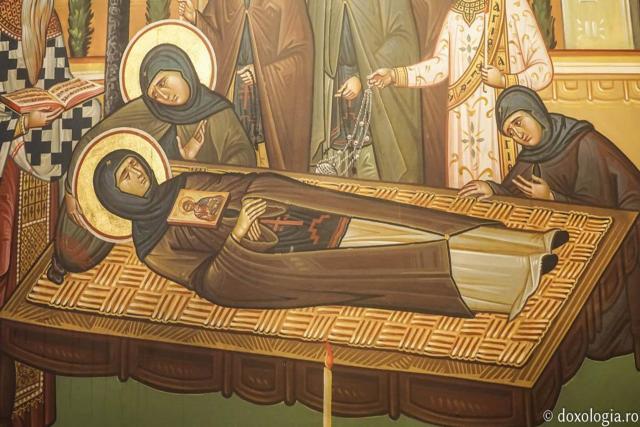
He fell asleep on April 17, 1805, and was buried in the courtyard of the Church of the Holy Apostles Peter and Paul in Chios, where his tomb is still found today. The translation of his holy relics took place in 1808. A multitude of healings were witnessed by the faithful who touched his relics. The inhabitants of the island of Chios honored him as a saint during his lifetime, a veneration that has spread throughout the whole Church.
English translation adapted from the Romanian life published by Doxologia.ro.