Saints Silas, Paisius, and Nathan of Sihăstria Putnei
Three 18th-century hesychast fathers who flourished at Sihăstria Putnei Monastery, serving as spiritual guides, defenders of Orthodoxy under Habsburg rule, and renowned miracle-workers whose incorrupt relics were rediscovered in 1990.
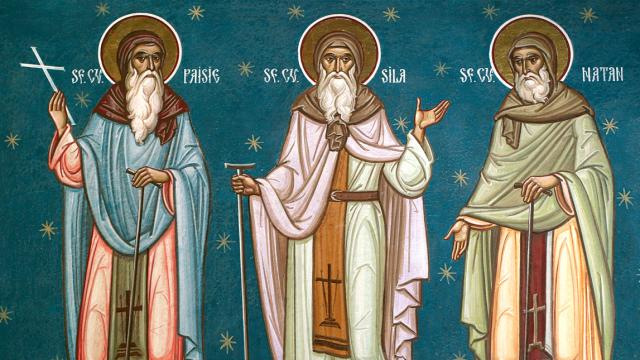
The monastic settlement of Sihăstria Putnei is documented in the second half of the 15th century, but the 18th century represents the most flourishing period in its history, due to the improved hesychasts who labored here. Three of these distinguished themselves spiritually in a completely unique way: the Venerable Silas (†1783), Paisius (†1784), and Nathan (†1784).
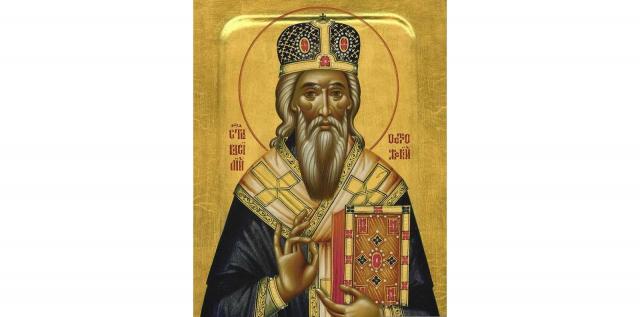
Saint Silas
Saint Silas was born in 1797 to pious parents, Ion and Ioana, and entered as a novice brother at Orăşeni Skete in Botoşani. After the death of his elder, Gideon, around the year 1714, Silas came to Sihăstria Putnei, where he was tonsured by Hegumen Theodosius. After the latter passed to the Lord, the new abbot, Dositheus, ordained him a deacon and then a priest, and later he was tonsured into the Great Schema. In October 1731, Metropolitan Anthony of Moldavia gave Silas his blessing to serve as the steward for the elderly Abbot Dositheus of Sihăstria Putnei, and at the end of 1753, he was named abbot of the skete by Metropolitan Jacob of Putna.
Saint Silas was a lover of the House of the Lord and of the divine services. Immediately after taking over the leadership, he desired to build a stone church in place of the very small wooden one. With the blessing and counsel of Metropolitan Jacob, he first moved the wooden church to the apple orchard, decreeing that the fathers of the skete should be buried around it. After that, on the same spot, he built a stone church which he adorned with an iconostasis, icons, and other decorations. The work lasted four years (1754-1758), and the church received the patronal feast of the Annunciation, being consecrated by Bishop Dositheus Herescu. He then built various annexes necessary for the skete’s management, a stone well and fountain, enlarged the enclosure and fenced it again, and built a new refectory and new cells.
Saint Silas was gifted by God with the gift of preaching, his word penetrating the hearts of people and working there the love for God and neighbor. Like another Chrysostom, Saint Silas was a teacher of almsgiving, teaching the rich to grow spiritually by giving away material things. Abbot Dositheus sent him to the boyars and rulers of Moldavia to obtain objects necessary for the proper order of the services, and later Metropolitan Jacob sent him to Wallachia to raise funds necessary for the restoration of Putna Monastery. Thus, we know of donations or confirmations of old privileges made by Voivodes Constantin Mihail Racoviţă, Scarlat Ghica, Ioan Teodor Calimachi, and Grigorie Ioan Calimachi, so that we can say that during the time of Hegumen Silas, Sihăstria Putnei experienced its most flourishing period, not only spiritually but also from an administrative and housekeeping perspective. He cultivated the gift of gratitude toward those who helped the skete, compiling a commemorative list (pomelnic) and charging his successors to remember them at the Holy Altar.
A scholarly activity that was not at all negligible also took place at Sihăstria Putnei. Unlike most monasteries and sketes, Sihăstria Putnei did not possess arable land that required a large volume of physical labor and deep involvement in administration, as the hesychasts here strictly observed the rules of the monastic schema. Spiritual life was, therefore, at the forefront; the hesychasts, through their prayers, sanctified themselves and helped the people who asked for their prayers, who in gratitude ensured their necessities for life. In the intervals between prayer and fleeting rest, the monks occupied themselves with translating, copying, and beautifying soul-profiting books. The scholarly care of Abbot Silas for the growth of his disciples was evident, as the "Ladder" of Saint John represented a true manual for the monks. Abbot Silas himself left us a precious document regarding the history of Sihăstria Putnei from its foundation until his time.
The last eight years of Abbot Silas's life were particularly difficult, as he had to endure many deprivations due to political changes. After the seizure of Bukovina by the Austro-Hungarian Empire (May 7, 1775), many prohibitions were placed on the skete. The usual donations of the Moldavian rulers ceased, so that in 1776, Abbot Silas drafted a letter addressed to Emperor Franz Joseph, asking for certain favors. The request, however, did not reach its destination. The elderly hesychasts were helped, however, by the former Metropolitan Jacob of Putna, now at his monastery of metania, by Bishop Dositheus of Rădăuți, and by pious Christians.
With much effort, Abbot Silas—helped by the Hieroschemamonks Nathan and Paisius and the other inhabitants, who showed great courage—managed to prolong the monastic life there despite material shortages and the intensifying Habsburg oppression.
In 1781, after 27 years as hegumen, the elderly Saint Silas retired from the leadership of the skete, leaving Hieroschemamonk Nathan as his successor. Following a hesychast custom practiced then, Bishop Dositheus Herescu wrote him a "letter of release," while also approving the community's choice of the successor.
Saint Silas lived two more years in the skete, and on April 23, 1783, he passed to eternal life at the age of 86, of which 70 were spent in labor at Sihăstria Putnei. On the way to Sihăstria Putnei, on the left side near the entrance to the monastery, is "Abbot Silas’s Spring," from which the faithful take water they consider blessed.
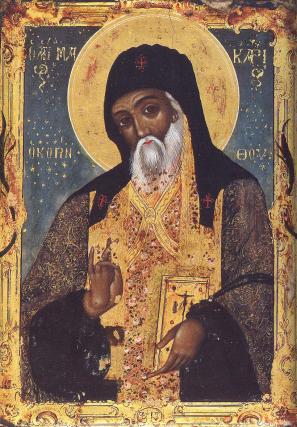
Saint Paisius
Saint Paisius was born in 1701, being of a similar age to Hegumen Silas, whom he had as a spiritual father at Sihăstria Putnei, just as he had Saint Nathan, the new abbot, for three years (1781-1784).
Among the few preserved details, it is known that he was hegumen at Saint Elijah Monastery during the reign of Constantin Cehan Racoviţă (somewhere between 1750-1757), after which he was sent to Râşca Monastery. Longing for more prayer and solitude, he retired to Sihăstria Putnei (before 1765), where he lived for two decades in the order of hesychast life. He passed to eternal life on December 16, 1784, at the age of 83.
In 1990, outside the church of Sihăstria Putnei, which was then in ruins, the tombstone of "the servant of God, Paisius the Hieroschemamonk" was found on the south side of the nave, and under the stone, the fragrant bones of the saint.
A contemporary of Abbots Silas and Nathan and a co-worker with them in the life of Sihăstria Putnei, Saint Paisius is honored together with them since the discovery of his holy relics, which are similar in appearance but possess a distinct fragrance.
Saint Nathan
Saint Nathan was born in 1717 in the Paşcani area and later called himself "the confessor from Paşcani."
He came to Putna Monastery, where he was made a ryassaphore with the name Nathanael and then ordained a hieromonk. Between 1760 and 1762, he was tonsured into monasticism with the name Narchis by Metropolitan Jacob. Longing for more prayer and stillness, somewhere between 1762 and 1768, he retired to Sihăstria Putnei, where he received the Great Schema with the name Nathan.
His cultural activity, especially before receiving the Great Schema, was particularly prolific. He wrote commemorative lists for the Metropolis of Moldavia, Putna Monastery, Doljeşti Skete, Saint Demetrius Church in Suceava, and Bisericani Monastery. Before coming to the Sihăstria, he translated from Slavonic a Compline service and the Canons of the Mother of God. Two works were drafted right at Sihăstria Putnei: the "Pomelnic of Sihăstria Putnei" (1768) and a translation from Slavonic of the "Order of Monastic Tonsure" (1770).
Because of his high life, Saint Nathan was chosen by Metropolitan Jacob to be his spiritual father, and from the hands of the venerable Nathan at Sihăstria Putnei, the metropolitan received the Great Schema with the name Euthymius.
After Saint Silas retired from the abbotship, Saint Nathan took over the leadership of the skete on March 10, 1781. Though already 64 years old, he continued the work of Saint Silas with much zeal and sacrifice, guiding the small community for three and a half years.
The hardships due to the harsh conditions imposed by the foreign regime increased. A letter from January 20, 1782, requesting material aid or bread and vegetables, reveals the unique way of life in this skete. It notes that the fathers refused to accept estates or serfs because they believed that "with estates and with serfs and with the working of the land and with cattle, without worries and quarrels, they would not be able to fulfill their prayers, services, and sacrifices according to the duty and order of their rank."
Saint Nathan was also a defender of the Romanian language, contesting the mandatory teaching of German in the primary schools of Bukovina under Austrian occupation. At the end of 1784, seeing the skete in ruins and Orthodox monasticism oppressed, Abbot Nathan wrote his will, revealing his renunciation of the world. After a bodily suffering by which he was "purified" like gold in a furnace, Saint Nathan moved to the Lord on the day after the feast of the Nativity, December 26, 1784.
Exactly one year later, at the end of December 1785, the order was given for the Sihăstria to close its church and for the remaining four monks to move to Putna Monastery. The memory of Saints Silas, Paisius, and Nathan remained in the consciousness of the Christians of the area as a symbol of a unique way of life.
The Discovery and Veneration of the Holy Relics
After more than two centuries of interrupted life, on April 24, 1990, reconstruction work began at the skete. Among the ruins of the church, the tombstones of Abbots Silas and Paisius were discovered, as well as their bones and those of Abbot Nathan, all yellow and beautiful. Before the reconstruction began, a monk from Putna named Nathanael saw a light come from the south that settled on the graves, circled the church, and went toward the north.
Today, the saints' relics are placed for veneration in a carved wooden reliquary in the porch of the Annunciation Church at Sihăstria Putnei. Many people have testified to receiving help by venerating these relics and praying to Saints Silas, Paisius, and Nathan.
Miraculous Deeds of Saints Silas, Paisius, and Nathan
The first iconographic representation of the saints was made following a miraculous event. A woman possessed by an unclean spirit came to Sihăstria Putnei. About 100 meters before the skete, three old men appeared to her with staffs in their hands, with which they began to drive out the unclean spirits. The woman was completely healed. When the painter of the church wanted to depict the three saints but did not know their appearance, the woman described them, and they were thus painted with large white beards and each holding a staff.
In 2001-2002, several people suffering from demonic attacks found peace after touching the relics of the saints, particularly those of Saint Paisius. A notable healing also occurred in 2012, when a woman from Roman was healed of metastatic bone cancer after her friend prayed to Saint Silas at his reliquary. Her tumor markers dropped from 3000 to 3, leaving her doctors speechless.
English translation adapted from the Romanian life published by Doxologia.ro.