Saint Nina, Equal-to-the-Apostles and Enlightener of Georgia
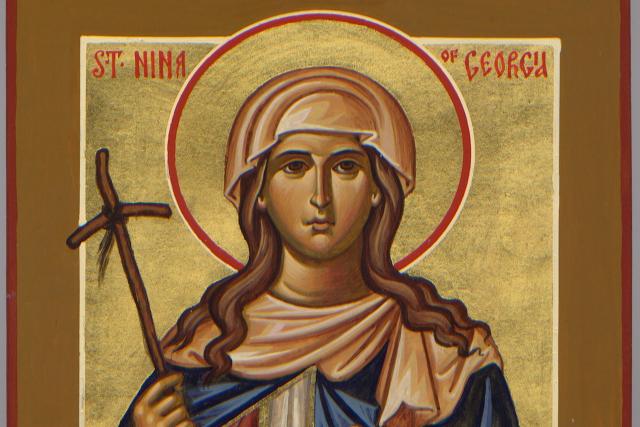
Born in Cappadocia, Saint Nina converted Georgia to Christianity through missionary work and miracles, guided by a vision of the Virgin Mary and a cross made of grapevine branches.
Saint Nina, Equal-to-the-Apostles ‒ the path to holiness
Known for dedicating her entire life to the Christianization of Georgia, Saint Nina, Equal-to-the-Apostles, desired to bring the Gospel to everyone's knowledge, having the missionary task of converting the Georgian population. She defeated idols and succeeded in building the first churches, bringing an entire nation to the faith.
Born in Cappadocia during the time of Emperor Maximian, Saint Nina was left in the care of Abbess Niofora in a monastery near the Holy Sepulchre after her father went into the wilderness and her mother went to care for the poor and sick. Wondering what happened to the Savior's robe after the Crucifixion, Mother Niofora told her that it was located in Georgia. So Saint Nina prayed to reach that place, and one night the Mother of God appeared to her in a dream and blessed her, giving her a cross made of grapevine branches—a cross that the young woman had in her hands when she woke up. With the bishop's blessing, she set out on the journey together with 30 virgins, but they were captured and beheaded because they would not renounce Christ; Saint Nina was the only one who managed to hide and even later to overthrow the temple of the god Armazi.
The first family converted was the one she lived with, because through Saint Nina's prayers, the barren Anastasia received healing. From then on, the miracles continued, as the saint had the power to cast out evil spirits. Even King Mirian believed in God after he was blinded because of a storm, regaining his sight through the prayer he had learned from Saint Nina. Thus, bishops were brought in, and the Christianization of the people and the building of churches began, for the Lord had shown the young woman through a vision where to build the first holy dwelling. Dedicated to the Holy Apostles, the church is said to be near the place where the Savior's robe was buried, along with the woman who had obtained it, and it has in its center the trunk of an oak tree from which healing myrrh still flows today.
Knowing that her end on this earth was approaching, Saint Nina wrote to King Mirian to inform him and to ask him to send Bishop John so she could be communed with the Holy Mysteries. Her body remained, as she wished, in the last poor village where she had preached, in Kakheti. Although people tried to move it, it could not be shifted. The grapevine cross also remained as a testimony, being placed in the Zion Cathedral in the city of Tiflis (Tbilisi).
English translation adapted from the Romanian life published by Doxologia.ro.