Synaxis of the Saints of Mount Athos
Commemorated on the second Sunday after Pentecost, this feast honors the countless saints who attained holiness on the Holy Mountain, including famous ascetics and hidden laborers of prayer.
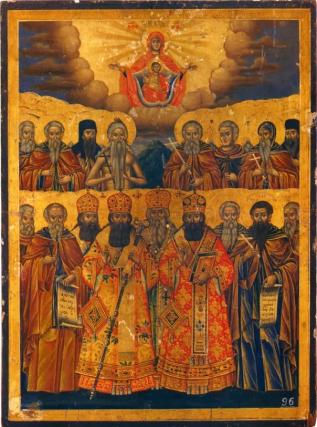
The Synaxis of the Athonite Saints. Portable icon of the Protaton Church. Work of Hieromonk Macarius of Galatista. 1859
On the third Sunday after the Descent of the Holy Spirit, we celebrate the memory of all the Venerable Fathers who shone forth through asceticism on the Holy Mountain of Athos.
The first Sundays after the feast of Pentecost show us that the purpose of the Holy Spirit's coming into the world is the sanctification of humanity. Thus, around this great feast, saints known and unknown, from all times and places, are honored. The celebration of the Sundays following the feast of Pentecost was established by the Church gradually. We first honor the Sunday of All Saints, when we celebrate all known and unknown saints. On the second Sunday after Pentecost, the Orthodox Churches honor their national saints—in our Church, the Romanian Saints are celebrated—and on the third Sunday after Pentecost, the Romanian Orthodox Church has established the honoring of the Athonite Saints, showing through this the connection our people have with the spiritual life of the Holy Mountain of Athos. The contributions of Romanian princes and boyars to support the Athonite monasteries during the 14th–19th centuries were most significant, and the presence of Romanian monks on the Athonite peninsula has been continuous from the 14th century to the present, with many Romanian monastics reaching great measures of holiness. Thus, on this Sunday, we honor all the saints who struggled on the Holy Mountain of Athos, some of whom are of Romanian kin.
Today, with distinguished joy, we highly honor the Mother of God, the Lady of the Mountain and the Abbess of all Athonite monasteries, she who chose and requested this Mountain as her inheritance from her Son, to protect zealous monks through her prayers. We then honor, as is our duty, the beginners of monastic life on Mount Athos: Saint Peter the Athonite (650-734), the first hermit of the Mountain, who, living in poverty, overcame countless demonic temptations through fasting and prayer; and Saint Athanasius the Athonite (920-1003), the founder of the Great Lavra and of cenobitic life on the Holy Mountain of Athos.
Today we celebrate the host of Saint Hierarchs who lived angelically in the Garden of the Mother of God and, with their teachings, enlightened the right-believing people. We honor Saint Gregory Palamas, Archbishop of Thessaloniki (1296-1359), a pillar of Orthodoxy, a great hesychast ascetic, theologian of the uncreated light, and victor over the heresies of Barlaam and Akindynos; Saint Philotheus Kokkinos, Patriarch of Constantinople (1300-1379), disciple of Saint Gregory Palamas, defender of Orthodoxy and hesychast intercessor; Saint Callistus I, Patriarch of Constantinople (†1363), disciple of Saint Gregory of Sinai and Philokalic writer; Saint Gerasimus Palladas, Patriarch of Alexandria (1645-1714), who lived for a time in Wallachia and then, toward the end of his life, retired from the patriarchal throne and struggled at Vatopedi Monastery; Saint Macarius Notaras, Bishop of Corinth (1731-1805), a teacher of the Philokalia and hesychast intercessor, a co-laborer with Saint Nicodemus the Hagiorite in printing soul-profiting books; Saint Gregory V, Patriarch of Constantinople (1745-1821), who was exiled to the Holy Mountain of Athos and later, on April 10, 1821, on the night of the Resurrection, while dressed in hierarchal vestments, was hanged by the Ottomans at the door of the Ecumenical Patriarchate; and other hierarchs of holy life who struggled on the Athonite Peninsula, known and unknown.
Also today, we bring praise to the consecrated monastics who served with zeal and piety, guiding monks and the faithful toward Christ. Thus, we celebrate the renowned spiritual fathers: Saint Porphyrios of Kavsokalyvia (1906-1991), who, struggling in deep humility, was glorified by God with the gift of prophecy and miracle-working; Saint Sophrony of Essex (1896-1993), who, being a disciple of Saint Silouan the Athonite, was deemed worthy of seeing the divine light; Saint Ephraim of Katounakia (1912-1998), who through patience sanctified his life, along with other hieromonks who reached perfection in the Garden of the Mother of God.
Today we also honor the host of Athonite monastics who struggled in monasteries, in deserts, in caves, and on the islands of the sea. With piety, we make memory of Saint Paul of Xiropotamou (10th c.), the builder of Xiropotamou and Saint Paul monasteries; Saint Simon the Myrrh-gusher (13th c.), founder of Simonopetra Monastery; Saint John Koukouzelis (1280-1330), who sang with a divine voice to the Most Holy Theotokos, from whom he received a reward; Saint Gregory of Sinai (1270-1346), who guided many monks to the blessed life, being a great teacher of prayer and a seer of the uncreated light; Saint Maximus of Kavsokalyvia (1280-1365), a great hesychast who cultivated the virtue of hiddenness, burning his huts to hide his spiritual work; Saint Nicodemus the Hagiorite (1749-1809), a fervent intercessor before God and publisher of the Philokalia in Venice (1782); Saint Silouan the Athonite (1866-1938), a prayer for the whole world and seer of divine light; Saint Joseph the Hesychast (1897-1959), who, through his disciples, revived monastic life on Mount Athos, thus becoming the spiritual father of many Athonite communities; Saint Paisios the Athonite (1924-1994), who shone through deed and word, being a guide for monks and the faithful at the end of the 20th century; and other venerable fathers who lived in the blessed land of the Holy Mountain of Athos, known and unknown.
In the course of time, many Romanian monks chose to live on the Holy Mountain of Athos. Among them, some became known for the charisms with which they were endowed by God, living in harsh struggles, in fasting and prayer. Some lived only for a period on the Holy Mountain and later, after learning the rule of life, returned to their country, bringing the Athonite rule to Romanian monasteries. Others struggled until the end of their lives on the Holy Mountain, being examples of humility and love for other monks.
Today we also honor the Romanian hierarchs who struggled for a time on Mount Athos and, through their teachings, guided multitudes of souls toward God: Saint Niphon, Patriarch of Constantinople (†1508), who in perfect humility pastored the Metropolis of Wallachia for a time; Saint Joseph the New of Partoș, Metropolitan of Banat (1568-1656), who, living in the Pantokrator and Vatopedi monasteries, reached great spiritual progress; Saint Gregory the Teacher, Metropolitan of Wallachia (1765-1834), a hesychast intercessor and translator of the writings of the Holy Fathers, who lived for a time in the Kalimitsa Wilderness near Vatopedi Monastery; Saint Callinicus of Cernica, Bishop of Râmnic (1787-1868), a strict ascetic, fervent intercessor before God, and guide to monks and the faithful, who struggled for a time at the Skete of Saint Anna, belonging to the Great Lavra.
Today we bring select hymns of honor to the venerable ones of Romanian kin who shone through their lives in the homeland of monks: Saint Nicodemus of Tismana (1320-1406), who, struggling for a period in Hilandar Monastery, then went to Wallachia where he became the beginner of cenobitic life; Saint Basil of Poiana Mărului (1692-1767), who, loving the virtuous life, spent time in asceticism on the territory of Pantokrator Monastery, becoming a teacher of the Jesus Prayer for many zealous monks; Saint Paisius of Neamț (1722-1794), a teacher of Philokalic teachings and renewer of hesychast life throughout Orthodoxy, who lived as a hermit in the cells of Iviron, Pantokrator, and Simonopetra monasteries; Saint George of Cernica and Căldărușani (1730-1806), who, receiving the angelic habit and ordination as a hierodeacon at Vatopedi Monastery, returned to Wallachia and became a follower of his spiritual father, Saint Paisius of Neamț, reviving monastic life in the Cernica and Căldărușani monasteries; Saint Macarius the Protopsaltis (1763-1836), who was formed in Pantokrator Monastery, singing with a sweet voice to the All-Pure Mother, his protectress and guardian. We also bring songs of praise to Saint Niphon of Prodromou (1799-1899), the first founder and abbot of the Romanian Skete of Prodromou, who, in perfect humility, reposed in the wilderness of Vigla; Saint Nectarius the Protopsaltis or the Vlach (1804-1899), the 'nightingale of the Holy Mountain' and teacher of humility, who with a sweet voice adorned the Athonite vigils; Saint Antipas of Calapodești (1816-1882), a disciple of Saint Niphon of Prodromou, who through the fiery prayer of the heart drove out unclean spirits; Saint Irodion of Lainici (1821-1900), disciple and spiritual father of Saint Callinicus, who lived for a time in the Skete of Lakkos belonging to Saint Paul's Monastery; Saint Arsenios of Prislop (1910-1989), who struggled for a short time together with Saint Seraphim of Sâmbăta de Sus (1912-1990) at the Cell of Saint Hypatius, belonging to Vatopedi Monastery; Saint Dionysius of Koltsou (1909-2004), a great spiritual father and teacher of the Jesus Prayer, who for his humility obtained from God the gift of miracle-working; Saint Petroniu (Tănase) of Prodromou (1916-2011), renewer of the Romanian skete and a discreet missionary through his spiritual letters sent throughout the world, as well as other saints known and unknown.
For their holy prayers, O Lord Jesus Christ, our God, have mercy on us and save us. Amen.
English translation adapted from the Romanian life published by Doxologia.ro.